
Visa Commercial Solutions Hub
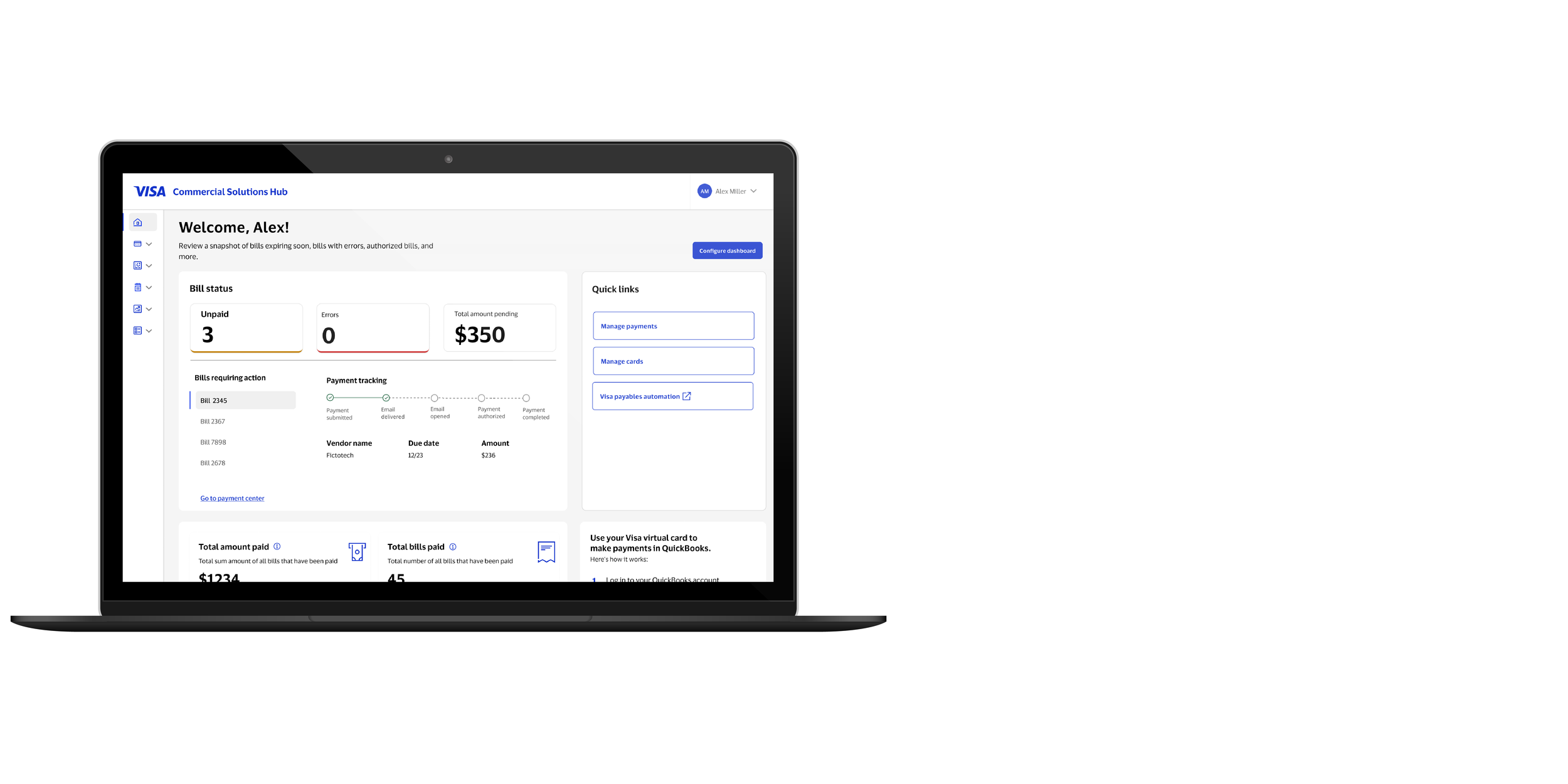
The Visa Commercial Solutions Hub is a commercial payments experience re-imagined for the modern world. It’s a single platform which simplifies payments for businesses, fintech service providers, and business users featuring a range of Integrated solution options.
Visa Commercial Solutions Hub demo
Summary
The Visa Commercial Solutions Hub is a new commercial payments ecosystem for financial institutions, fintechs, and business users from mid to large-size companies in Visa’s Commercial and Money Movement Solutions (CMS) portfolio. It provides a range of commercial payment solutions to empower users to streamline their payments, manage their working capital, and boost efficiency. It also offers an array of integrations and additional capabilities and services.
The integrated platform is a personalized and consistent experience for users to easily navigate and accomplish crucial payment tasks. With a single sign-on structure, efficient onboarding process, and a menu of services to choose from, users can expect a faster, more efficient self-service experience than what was previously was available at Visa and the industry.
Prior to the general availability of this platform, users were accessing individual Visa products in a piecemeal capacity, which is less efficient for banks, business users, and for Visa. The core product in the roadmap started with B2B Payables (formerly Visa Payables Automation), and are continuing with over 25 products and services that plug into an array of existing Visa platforms, all on a scalable, headless architecture. The platform also features several instances of agentic and generative AI capabilities which can better surface business intelligence to bank admins, generate data visualizations for a range of users, and offer an enhanced support experience. As the Content Design and Strategy Lead on this platform, I manage an array of projects and have supported over 20 designers in the portfolio. In other words, this platform is massive.
User needs & pain points
Issuer and business user needs and pain points:
The system did not recognize existing clients, creating inefficiencies in the onboarding process.
Customers had multiple entry points (URLs) to access each product.
Customers had difficulties navigating between the different platforms and systems, causing tasks to take longer with higher learning curves.
Customers experienced complexity in implementation across disparate products.
Customers experienced confusing content and naming conventions.
Costumers found an inconsistent UI experience across products.
The overlapping and duplicate product capabilities across similar products was costly for customers.
Visa pain points
Visa offers an expansive set of commercial products and platforms, but they are hard to sell and implement:
Visa experienced a higher cost associated with supporting, maintaining, and developing each separate system and platform.
The long lead time to onboard customers delayed time to revenue.
Technology teams work inefficiently by supporting duplicative product functionality, integration services, and currency/language internationalization.
Visa sales team must select the “best fit” for customers at the time of sale, which is not scalable, especially because it’s so hard for them to purchase additional products.
Our goals
Our goals are captured by our yearly-created and quarterly-updated Objectives and Key Results (OKRs). Here’s an example:
Deliver purpose-driven VCS Designs that contribute to the sustainable net revenue growth for the user-centered commercial experiences across mid-size to large market segments.
All our VCS Hub work streams fall under this Objective with a range of Key Results tailored to the content work I lead and support.
The team
Our team includes a multidisciplinary group of 7 to 10 product designers at any given time, help from 2-3 design engineering partners (front end developers), 10 or so back-end engineering teams spread across the world (located in the United States, Poland, and India), an entire product management organization (too many product managers to count), 2 content designers, 1 accessibility specialist, and a team of 5-6 design researchers. For context, some of our technical engineering teams have upwards of 70 engineers. The multidisciplinary team supports the entire Commercial and Money Movement Solutions portfolio. I began working on this team in October of 2023.
The Visa Commercial Solutions Hub is now generally available. Hear from Senior Vice President of Visa Commercial Solutions, Gloria Colgan about its release.
Payments re-imagined for the modern world.
Contribution
Content design leadership and strategy
As the content design lead on this portfolio, I set the content design strategy across the portfolio’s product experiences, with VCS Hub being our highest priority. I have supported over 20 product designers, along with one other content designer. The scale of our product content design team is lean but we ruthlessly prioritize using a design support model we devised (embedded, review, or consultation). We perform an array of duties including leading strategic projects that align to: the information architecture (IA), the AI and agentic strategy, AI-assisted contextual help, terminology, language internationalization, standards, quality assurance, the authoring of product content, writing error and alert messages, and more. We author and maintained a centralized strategy which we share often with partners to enable them. I also manage relationships with product managers and technology partners to ensure we have cross-functional alignment as our project increasingly grows in complexity.
Information Architecture
The content team is responsible for establishing and maintaining the navigation schema and sitemap. We have unified the Visa Commercial Solutions Hub through a navigational layout which will set the platform up for scalability. The team originally built a horizontal navigation, and we quickly realized it wouldn’t scale. We performed some research and adjusted our strategy to allow for growth using a mixed navigation that relies heavily on the vertical navigation. This work stream is challenging because it involves every product manager and technology team. We have to continually align our design to our labeling strategy, and organize all the pages within the Hub to optimize for findability. We also need to understand how the experience is customized for each user role, and perform tests with design research to validate our choices. We use our taxonomic abilities and knowledge of ontology to help us make decisions. Yet, the main challenge is a very human one—change management. We must continuously challenge the mental models that currently exist on our team and sometimes introduce new and unfamiliar terms and organizational structures. It can be mental gymnastics!
Agentic strategy
I lead the agentic strategy in partnership with a few designers on VCS Hub. Content design as a discipline is increasingly important to the practice of AI, since LLMs are content and text-based, and the subdiscipline of conversational design is increasingly setting up content designers with “main character energy.” The agentic system we’re architecting will have a variety of agents that perform different tasks , seamlessly acting in tandem to help serve to the user for their final decision making. This could be things like onboarding, where the agent will automatically fill out what used to be manual and time-consuming forms. It will also help with facilitating payments, contextual help, travel, and more. Content design specifically aids with formatting different intents and entities, creating system prompts to guide different chat patterns and formats, and more. We add a layer of quality and user-specificity to a probabilistic converational system.
AI-powered help assistance
Visa Assist is a product within the consumer portfolio at Visa. Currently, it is an AI-assisted chat experience accessed through the Visa Access portal, and can help users connect to documentation and answer Visa-related questions. Previously, it had not been leveraged as an integrated chat within a large Visa platform or product; users could only access it separately. I identified the need to partner with the Visa Assist team and build a use case for our platform where the chat interface can be directly embedded for easy access to contextual help. In its simplest form, it could provide how-to tutorials from documentation data, provide definitions, or help point users to where they need to go. In its second phase, it will also have the ability to retrieve the custom data contained within our platform. This could eventually serve a variety of more sophisticated contextual help and assistance use cases. It could fetch some important payment data, proactively help a user make a payment or recommend how a user manages money via forecasting and predictive models. Eventually, it could grow in sophistication and even generate rich media content, such as tutorial videos, to help users with their tasks. I lead a successful workshop with several Vice Presidents and our respective teams to plan for this collaboration and it is currently underway in phase 1.
Components and patterns task force
In order to ensure consistency and quality standards across our platform, we needed more cohesion across what we were building—with 7 to 10 designers at any given time, every designer has their own approach. Our design system can at times be too flexible; thus not customized enough for our particular commercial use case. Design flows from different designers came out looking different; from different variations in spacing, layout, placement, and more. From this issue, the components and patterns task force was born! I established this group using my background on the Visa Product Design System. A core group of our Hub designer leads work together to build and align on standards that are developed with the Visa Product Design System as a base. From there, we establish unique patterns and customizations which build off of the out-of-the-box components. For example, we created our own bespoke version of tables with our own filtering, search, and data requirements in mind. We are a governance body for scaling our design process—we make decisions, down to the pixel, on what our Hub should look like and how it should behave! And, we keep a decision log to ensure we remember and can call back to what we agreed on.
Customized standards we have developed include:
Agentic AI strategy
Button size and placement
Conversational design guidelines
Custom landing page standards for different users
Empty states
Error and alert messaging standards including Flags, Section Messages, and Dialogs (contnet lead)
Filter guidelines
Fonts and Type
Forms
Footer
Grid and spacing
Iconography
Loading patterns
Microinteractions and motion
Navigation (content lead)
Notifications strategy
Page templates
Panels
Reports
Responsive layout
Status and badges
Stepper patterns
Tables
Tabs
Toggles
Tooltips
Redlines
White label and cobranding
Terminology
The content design team maintains a terminology document for when we introduce new terms in the Hub. Both users and internal team members might be unfamiliar with new terms as we design our content with more human language in lieu of robotic or overly technical language. This was created as an artifact of alignment and change management. We also established a governance process for introducing new terms across the UI layer, the back-end layer, and the API layer that banks use to integrate our data. This helps align our design, product, and tech partners and showcases how we introduce the new terms into the Hub. It also demonstrates how we use tooltips and descriptions to help nurture users to understand the changes.
We also maintain a terminology database where we have defined over 500 terms in our portfolio, including those that are crucial to our current releases. This can help the entire portfolio align on terminology, which in my experience sounds easy but is in reality ridiculously challenging when you work at an enterprise scale designing a massive payments platform.
Common services
There are a number of common services, which are architectural, structural, or overarching services that support the Visa Commercial Solutions Hub and enable it to function at scale. Two notable work streams include language translation and entitlements (Identity and Access Management), which concerns bundles, roles, and permission across the Hub. While I am not accountable for the work, I act as the design point of contact and stay informed of the latest strategy to ensure our team is aligned with product and technology.
Impact
The Visa Commercial Solutions Hub reached general availability at the end of 2025. It represents Visa’s commitment to democratizing access to commercial payment technology, serving it to customers as a unified solution. According to this GA announcement, at launch, these included:
AI-Powered Payables: Automate accounts payable with GenAI-driven workflows that anticipate business needs, optimize cash flow and reduce manual bottlenecks.
Embedded Payments: Integrate payment capabilities into business applications—accounting, ERP or custom workflows—using Visa’s open APIs and intelligent orchestration.
Reporting and Insights: Harness advanced analytics and GenAI to surface actionable insights, predict trends and empower smarter business decisions in real time.
Personalized Experiences: User experiences can be tailored by AI, delivering recommendations, alerts and next steps that drive growth and efficiency.
Revenue, revenue targets, and detailed roadmaps remain largely publicly unavailable.